How to Stop Phone Distraction: A Proven Mechanism
You want to know how to stop phone distraction, and I suspect you've already tried the obvious: willpower, guilt, a folder on the second screen called Later. It didn't hold. That's not a character flaw. That's a design mismatch between a nervous system built for scarcity and a device engineered…
TL;DR
- Your phone isn’t stealing willpower — it’s exploiting a dopamine-driven prediction loop your brain runs automatically.
- The reliable fix is environmental: remove the cue, add friction, and give the checking urge somewhere else to go.
- Attention returns not through shame but through design — change what your hand can reach and the habit starves.
What’s in this guide
- Why is your phone so distracting?
- The variable reward loop explained
- How to stop phone distraction: the core moves
- Adding friction: the quiet superpower
- What to do with the checking urge
- Which tactics actually work?
- Key takeaways
- Frequently asked questions
You want to know how to stop phone distraction, and I suspect you’ve already tried the obvious: willpower, guilt, a folder on the second screen called Later. It didn’t hold. That’s not a character flaw. That’s a design mismatch between a nervous system built for scarcity and a device engineered by teams of behavioural scientists to be irresistible.
Here’s the reframe that dissolves the self-blame. The pull you feel isn’t weakness — it’s a prediction. Your brain has learned that the glass rectangle sometimes contains something good, and it keeps checking on the off-chance. Real change isn’t magic, it’s mechanism. And once you understand the mechanism, the tools stop sounding like platitudes.
 The reach happens before you decide to reach. That’s the loop we’re going to interrupt.
Why is your phone so distracting?
Your phone is distracting because it hijacks the brain’s reward-prediction system — the same dopamine circuitry that once tracked berries and predators. It’s not about entertainment; it’s about anticipation.
It’s 11:40pm. You picked up your phone to check the time. Forty minutes later you’re deep in a stranger’s holiday photos, and you couldn’t tell me how you got there. Notice what actually happened: no decision, no deliberation. A cue fired, a routine ran, and consciousness only arrived after the fact.
Neuroscientist Wolfram Schultz’s landmark work on dopamine (published in Science, 1997) showed something counterintuitive: dopamine spikes not when you get the reward, but when you anticipate one. The wanting fires before the having. Your phone is a wanting machine. That craving you feel isn’t hunger for the content — it’s hunger for the possibility of content.
The variable reward loop explained
The single most addictive feature of any phone is the variable reward — you never know whether a check will deliver something good, so you keep checking. Predictable rewards bore us; unpredictable ones obsess us.
B.F. Skinner mapped this in the 1950s with his operant conditioning chambers. A pigeon that gets a food pellet every time it pecks pecks calmly. A pigeon that gets a pellet sometimes — on an unpredictable schedule — pecks frantically and won’t stop. That intermittent schedule is the most powerful reinforcement pattern we know of.
Now look at your notifications. Most are noise. But sometimes there’s a message that matters, a like that lands, a piece of news that grips you. Your brain treats the whole platform as a slot machine, because functionally it is one. This has an everyday name and a clinical cousin: the compulsive check shares its wiring with the pull that keeps a gambler at the machine long past reason.
The urge to check isn’t a hunger for information. It’s a bet you keep placing because it occasionally pays out.
How to stop phone distraction: the core moves
To stop phone distraction, you don’t fight the urge — you dismantle the cue that triggers it. Willpower is a poor tool for a battle fought thousands of times a day; environment is a far better one.
Here’s why willpower keeps losing. Every check is a rehearsal. Every rehearsal strengthens the neural pathway, which is the whole reason why willpower fails against engineered habits. You can’t out-discipline a loop that fires faster than conscious thought. So we intervene earlier — at the cue.
The core moves, in order of leverage:
- Kill the notifications. Turn off everything except calls and, if you must, messages from named humans. Notifications are the injected cue — remove them and the loop loses its trigger.
- Greyscale the screen. Colour is a reward signal. Draining the saturation makes apps visibly duller and measurably less compelling.
- Move the apps. Bury social and news apps off the home screen, or delete the apps and use the browser — friction the mere act of opening them.
- Create a physical distance. When you work, put the phone in another room. Research from the University of Texas (Ward et al., 2017) found that the mere presence of a phone on the desk — even face down, even switched off — reduced available cognitive capacity. Out of sight genuinely means more mind.
Each move targets the cue, not your resolve. That’s the shift: you’re editing the environment that produces the behaviour, which is the same principle behind learning how to break a bad habit of any kind.
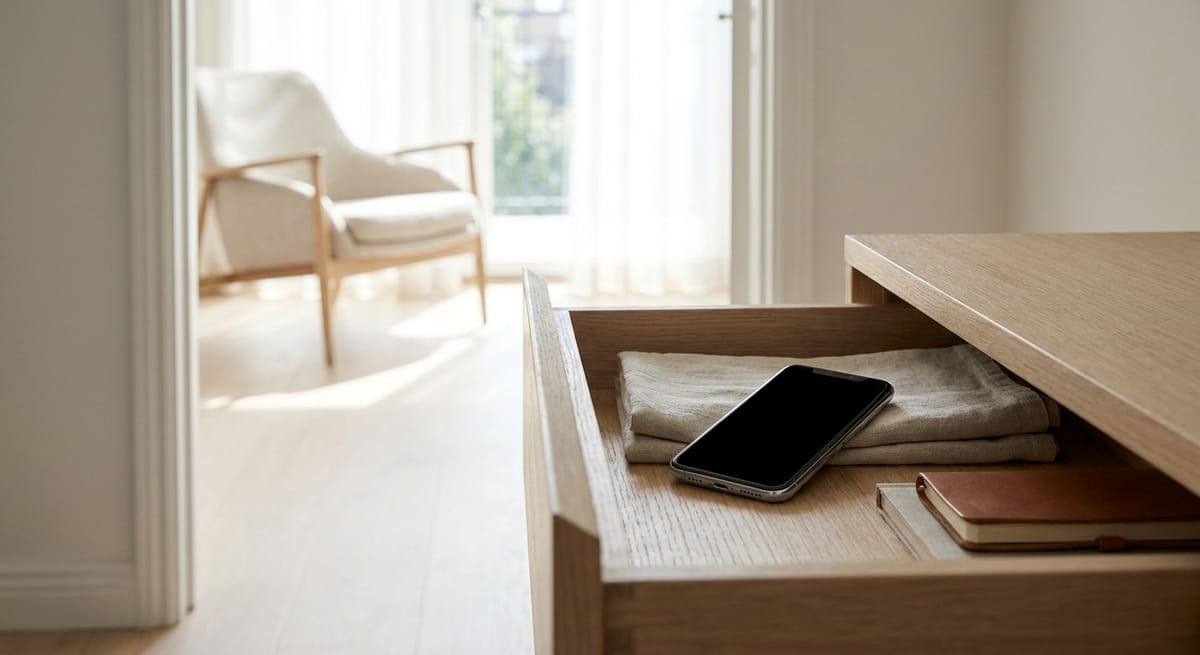 Distance is friction. Friction is the cheapest attention upgrade you’ll ever install.
Adding friction: the quiet superpower
Friction is any small obstacle between you and the automatic behaviour — and increasing it is the most reliable way to weaken a habit. Convenience is the fuel; remove it and the fire dims.
Behaviour scientist BJ Fogg puts it simply: behaviour happens when motivation, ability and a prompt converge. You can’t always lower your motivation to check — but you can lower your ability by making the check harder. This is the mirror image of how you reduce friction habits you want to build: for habits you want to break, you add it back in.
Practical friction to install today:
- Log out of the apps you doom-scroll, so each visit demands a password.
- Use a rubber band around the phone as a physical pause — a tiny prompt that asks do I actually want this?
- Set the phone to charge overnight in the kitchen, not the bedroom, so the first and last cues of the day disappear.
- Switch to a plain analogue watch, so checking the time no longer opens the slot machine.
None of these require heroic discipline. That’s the point. They shift the effort from your fragile in-the-moment willpower to a decision you make once, in advance, when you’re calm.
What to do with the checking urge
When the urge arrives, don’t suppress it — surf it. An urge is a wave: it rises, peaks and falls, usually within ninety seconds if you don’t feed it.
Suppression backfires. Try not to think of a white bear, as psychologist Daniel Wegner famously demonstrated, and the bear is all you’ll think about. Fighting the urge head-on just amplifies it. Instead, name it. “There’s the checking urge.” Naming engages the prefrontal cortex and dampens the limbic charge — a small act of emotional granularity that gives you a half-second of choice.
Then redirect. The urge is really asking for stimulation or relief. Give it a designated alternative — a glass of water, three slow breaths, a stand-and-stretch. If the reach is anxiety-driven rather than boredom-driven, a single physiological sigh settles the nervous system faster than any scroll ever will. You’re not white-knuckling. You’re offering the loop a different exit.
Which tactics actually work?
Not all interventions are equal. The ones that reshape your environment beat the ones that rely on in-the-moment resolve, because they don’t depend on you being strong at your weakest moment.
| Tactic | Targets | Effort required | Durability |
|---|---|---|---|
| Turn off notifications | The cue | One-time, low | High |
| Phone in another room | The cue + capacity | Daily, low | High |
| Greyscale screen | The reward signal | One-time, low | Medium-high |
| App timers / blockers | The routine | Setup + willpower | Medium |
| “Just try harder” | Willpower only | Constant, high | Low |
The pattern is clear: leverage lives upstream, at the cue and the reward, not downstream at the point of temptation. Pair a friction move with a positive habit — reading a real book where the phone used to sit — and you can use temptation bundling to make the better option the easier one. You’re not just removing a bad loop; you’re crowding it out with a better one.
Key takeaways
- Phone distraction is a dopamine-driven prediction loop, not a moral failing — the wanting fires before you decide anything.
- Variable rewards make apps as compulsive as slot machines; that’s engineered, not accidental.
- Attack the cue, not your willpower — notifications off, phone out of the room, screen greyscaled.
- Friction is the cheapest fix: make the check slightly harder and the habit starves.
- Surf the urge, name it, and redirect it — don’t suppress it, or it grows.
- Environmental design beats discipline every time, because it doesn’t depend on you being strong when you’re tired.
Frequently asked questions
What’s the fastest way to stop phone distraction?
The fastest way to stop phone distraction is to put the phone in another room while you work and turn off all non-human notifications. This removes the two most powerful cues at once — proximity and interruption. Research shows even a silent phone on the desk drains attention, so distance, not discipline, delivers the quickest measurable gain.
Why can’t I just use willpower to resist my phone?
Because the checking loop fires faster than conscious deliberation — the reach happens before the decision. Every check also rehearses and strengthens the pathway. Willpower is a scarce, tiring resource fighting an automatic behaviour thousands of times a day. Redesigning your environment removes the fight entirely, which is far more sustainable than constant resistance.
Do app timers and screen-time limits actually work?
They help, but modestly. Timers target the routine rather than the cue, and most people simply tap “ignore limit” when the urge peaks. They work best combined with friction — logging out, greyscale, physical distance — so the block isn’t the only thing standing between you and the app. On their own, they lean too heavily on willpower.
Is phone distraction a form of addiction?
It shares wiring with addictive behaviours — the same intermittent-reward schedule that keeps gamblers at machines — but for most people it’s a strong habit rather than a clinical disorder. That distinction matters because habits respond well to environmental change. If checking causes genuine distress or you can’t reduce it despite real effort, it’s worth speaking to a professional.
How long until my attention recovers?
Most people notice a calmer, less twitchy attention within one to two weeks of removing cues consistently. The urge to check fades as the loop goes unrewarded — extinction, in behavioural terms. It rarely vanishes completely, but it stops running the show. Consistency of the environmental change matters more than heroic willpower on any single day.
Ready to go deeper on the mechanisms behind lasting change? Explore our Habits collection, or if you want the loop that keeps your mind checking even when the phone is away, read how to stop overthinking. Understand the mechanism, and the tools stop sounding like platitudes.