Identity-Based Habits: How Change Finally Sticks
"No thanks, I'm trying to quit." "No thanks, I'm not a smoker." Two people declining the same cigarette — same refusal, entirely different machinery underneath. Identity-based habits are the reason the second person will almost certainly still be smoke-free next…
TL;DR
- Identity-based habits work by changing the belief that drives the behaviour, not just the behaviour itself.
- Every action you take is a small vote for the kind of person you believe you are — repetition rewrites the self-concept.
- Start absurdly small: prove the new identity with evidence your brain can’t argue with, then let it compound.
What’s in this guide
- What are identity-based habits?
- Why do outcome-based goals keep failing?
- The mechanism: how a habit becomes a vote
- How do you build an identity-based habit?
- Identity vs outcome vs process: a comparison
- Common traps and how to sidestep them
- Key takeaways
- Frequently asked questions
“No thanks, I’m trying to quit.” “No thanks, I’m not a smoker.” Two people declining the same cigarette — same refusal, entirely different machinery underneath. Identity-based habits are the reason the second person will almost certainly still be smoke-free next year while the first is white-knuckling it.
The distinction comes from James Clear, who writes in Atomic Habits that “the goal is not to read a book, the goal is to become a reader.” It sounds like a slogan until you see the neurology beneath it. And that’s my whole stance here: change holds when you understand the machinery driving it, not when you wrestle the behaviour head-on.
In this guide I’ll show you what identity-based habits actually are, why goal-chasing so often collapses, and the specific, evidence-grounded steps that make a new self-concept stick.
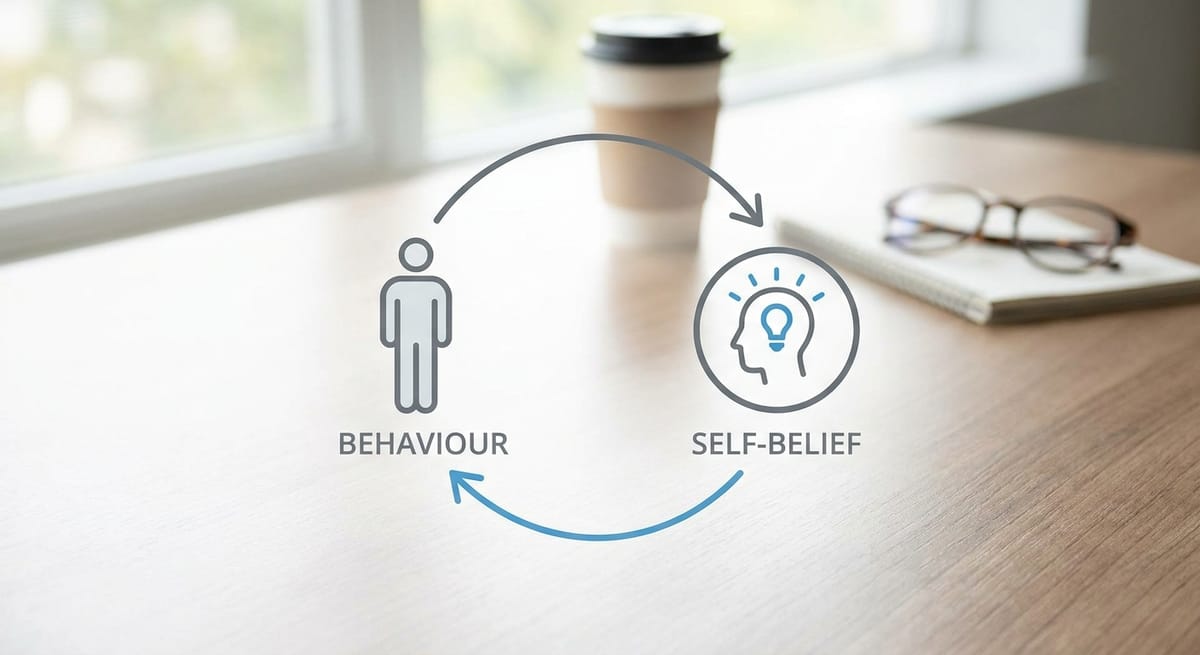 Behaviour and identity form a loop — each action is a vote for who you believe you are.
What are identity-based habits?
Identity-based habits are behaviours you perform because they express who you believe you are, rather than to hit an external target. The change starts at the level of self-concept — “I am a runner” — and the actions follow naturally from that belief.
Most people work the other way round. They set an outcome (lose 10kg), reverse-engineer the actions (gym three times a week), and hope the identity arrives at the finish line. Identity-based habits flip the sequence. You decide who you want to become, then let small, repeated proofs build that identity from the ground up.
The word that matters is evidence. Every time you act like the person you want to be, you cast a vote for that identity. Enough votes, and the belief becomes self-evident — no longer something you’re forcing, just something you are. This is why lasting habit change and changing limiting beliefs are the same project viewed from two angles.
Why do outcome-based goals keep failing?
Outcome-based goals fail because they rely on willpower to bridge the gap between who you are and what you’re trying to do — and willpower is a finite, unreliable fuel. The moment motivation dips, the behaviour has no deeper anchor.
Think of it as a tug-of-war. On one side, your goal. On the other, your existing self-image quietly whispering, “but that’s not really you.” As long as the two disagree, you’re fighting yourself. Research on self-regulation, including the much-debated ego-depletion work of Roy Baumeister, suggests that effortful self-control feels costly and degrades under load — which is one reason willpower fails as a long-term strategy.
Psychology has a formal name for this struggle: self-discrepancy. Psychologist E. Tory Higgins described the tension between the self you are and the self you feel you ought to be — and how that gap generates its own low-grade distress. Outcome goals widen the gap. Identity-based habits close it, because you’re no longer performing a role that contradicts you.
When you can see how the loop actually works, the advice stops sounding like a motivational poster and starts sounding like an instruction manual.
The mechanism: how a habit becomes a vote
The mechanism is a feedback loop: you act, the brain observes the action, and it updates its model of who you are. Behaviour shapes belief, and the updated belief makes the next instance of the behaviour easier.
Two well-established principles power this loop.
Self-perception. Psychologist Daryl Bem’s self-perception theory holds that we infer our attitudes partly by observing our own behaviour — the same way we’d read someone else. Act like a writer for thirty days and your brain reaches the obvious conclusion: apparently, I’m a writer. You’re not lying to yourself; you’re presenting evidence.
Repetition and familiarity. The more often a behaviour recurs, the more “natural” and less effortful it feels — a cousin of the mere exposure effect, where familiarity breeds preference. What begins as a deliberate choice becomes an automatic expression of self.
This is also why affirmations alone don’t work. Standing in the mirror declaring “I am a confident person” gives your brain a claim with no supporting evidence — and the brain, being a decent detective, dismisses it. Identity-based habits supply the evidence first. The belief follows the proof, not the other way round.
 Small actions accumulate into a self-concept the brain can no longer dispute.
How do you build an identity-based habit?
You build an identity-based habit by naming the identity first, then choosing the smallest possible action that proves it — and repeating that proof until the belief becomes automatic. Here’s the sequence I’d walk a client through.
- Name the identity, not the outcome. Not “I want to run a marathon” but “I am someone who trains.” Identity is durable; outcomes are finish lines you cross once.
- Ask the identity question. Before a decision, ask: “What would a [runner / calm person / reader] do here?” You’re outsourcing the choice to the self you’re becoming.
- Shrink the proof. Make the first vote laughably easy — put on the running shoes, read one page. The two-minute rule exists precisely to lower the bar until refusal is absurd.
- Reduce friction. Lay the shoes by the door tonight. Making the identity-consistent action easier to start is a core way to reduce friction in habits.
- Anchor it to something existing. Bolt the new proof onto an established routine using habit stacking — “after I pour my morning coffee, I write one sentence.”
- Count the votes, forgive the misses. You’ll skip days. That’s fine. A democracy isn’t lost on one abstention; you simply need to win the majority. Reframe, don’t blame.
Belief in your own capacity to keep casting these votes has a name — self-efficacy, from Albert Bandura’s work — and it grows fastest from small, genuine wins rather than pep talks.
Identity vs outcome vs process: a comparison
Identity-based habits, outcome-based goals and process-based systems aren’t rivals — they answer different questions. But identity is the layer that determines whether the other two survive a bad week.
| Dimension | Outcome-based | Process-based | Identity-based |
|---|---|---|---|
| Core question | What do I want to achieve? | What system will I run? | Who do I want to become? |
| Example | Lose 10kg | Gym Mon/Wed/Fri | I’m an active person |
| Motivation source | External reward | Structure & cues | Self-consistency |
| Vulnerable to | Hitting the target then quitting | Life disrupting the routine | Slow to establish |
| Durability | Low | Medium | High |
The strongest approach layers them: an identity at the base, a process that expresses it, and outcomes as feedback rather than the point. When the process breaks — and it will — the identity keeps you returning to it.
Common traps and how to sidestep them
The most common trap is declaring an identity your behaviour hasn’t yet earned, then feeling like a fraud when the belief won’t take hold. The fix is always the same: more evidence, smaller steps.
- The affirmation trap. Claiming the identity without the proof. Reverse it — act first, let the brain draw its own conclusion.
- All-or-nothing thinking. Treating one missed day as proof you “aren’t really” the new person. This is a textbook cognitive distortion; catch it and use cognitive reframing to soften the verdict.
- Identities that are too big. “I’m an athlete” is hard to prove on a Tuesday. “I’m someone who moves every day” is easy — and just as identity-shaping.
- Ignoring the fixed-mindset undertow. If you secretly believe traits are permanent, votes feel pointless. The research on growth mindset versus fixed mindset is your ally here.
Notice the theme: every trap is a belief problem masquerading as a behaviour problem. Identity-based habits work precisely because they treat it at the right level.
Key takeaways
- Identity-based habits change the belief that drives behaviour, not just the behaviour — which is why they outlast willpower.
- Every action is a vote for a version of yourself; the brain reads its own conduct as evidence (self-perception theory).
- Name the identity first, then supply the smallest possible proof, and repeat until it feels automatic.
- Affirmations fail because they skip the evidence; identity-based habits deliver the proof before the claim.
- Layer identity beneath process and outcome — it’s what brings you back after the inevitable off-week.
Frequently asked questions
What are identity-based habits in simple terms?
Identity-based habits are behaviours you repeat because they express who you believe you are, rather than to hit a target. Instead of “I want to write a book,” you adopt “I am a writer” and let small daily actions prove it. The belief drives the behaviour, and the behaviour reinforces the belief — a self-sustaining loop that outlasts motivation.
How long does it take to form an identity-based habit?
There’s no fixed number, despite the popular “21 days” myth. Research by Phillippa Lally at University College London (2010) found automaticity took a median of 66 days, ranging widely from 18 to 254. Identity shifts follow the same uneven curve: what matters is consistency of the small proof, not a countdown.
Why do affirmations fail where identity-based habits succeed?
Affirmations supply a claim with no evidence, so the brain — a natural sceptic — dismisses it, sometimes worsening self-doubt. Identity-based habits reverse the order: you act first, and the brain infers the identity from observed behaviour. Belief follows proof, not the other way round, which is why the change feels earned rather than forced.
Can I change more than one identity at a time?
You can, but it’s rarely wise early on. Each new identity competes for the same limited attention and self-control. Establish one until its votes run on autopilot, then add another. Focusing on a single high-leverage identity — a keystone change — often triggers improvements elsewhere without direct effort.
What if my behaviour contradicts the identity I want?
Expect it — no one wins every vote. A single lapse doesn’t overturn an identity any more than one missed election overturns a democracy. Treat it as data, not a verdict: reframe the miss, return to the smallest possible proof, and keep the majority of votes pointing the right way.
Ready to put this into practice? Explore more mechanism-first tools in our Habits collection, or if you’re new here, begin with Start Here to find your first small vote.