Why do I procrastinate? The essential emotion regulation fix
If you've ever asked yourself "why do I procrastinate?" while watching a Wikipedia rabbit hole about the history of the spork swallow your afternoon whole — you're in the right place. You had every intention of writing that proposal, filing those taxes, or having that difficult conversation. You…
TL;DR
- Procrastination is not laziness — it’s your brain trying to regulate uncomfortable emotions in the moment.
- Your brain’s threat response overrides its planning circuits, so short-term mood relief wins out over long-term goals.
- Self-compassion, affect labelling, and micro-actions are the science-backed tools that actually break the cycle.
What’s in this guide
- The great myth: why “laziness” is a lazy explanation
- The wolf in sheep’s clothing: productive procrastination
- The Zeigarnik effect: why delaying fries your mental RAM
- What’s actually happening in your brain when you delay
- What emotions are we actually avoiding?
- The shift: from self-blame to self-compassion
- How do I stop procrastinating? 4 science-backed strategies
- Key takeaways
- Frequently asked questions
 Procrastination isn’t a willpower problem — it’s an emotion regulation problem.
If you’ve ever asked yourself “why do I procrastinate?” while watching a Wikipedia rabbit hole about the history of the spork swallow your afternoon whole — you’re in the right place. You had every intention of writing that proposal, filing those taxes, or having that difficult conversation. You sat down. You resolved to get it done. And then, somehow, cleaning the crumbs out of the toaster felt like a matter of national security.
When you finally snapped out of it, the shame arrived right on cue. “Why am I so lazy? Why can’t I just have some discipline?” Here is the truth, backed by modern psychology and neuroscience: you are not lazy. You do not lack willpower. You have an emotion regulation problem.
That’s not a cop-out — it’s a mechanism. And once you understand the mechanism, you can actually change it. Let’s break down what’s happening in your brain and how to rewrite the script.
The great myth: why “laziness” is a lazy explanation
Procrastination is not laziness — and conflating the two actively makes things worse. Laziness is apathy: a lack of desire to do anything at all. Procrastination is the opposite. When you procrastinate, you care too much. You’re feeling a high volume of stress, anxiety, or overwhelm about the task, and your brain is hunting for an immediate escape route.
For generations, society has framed procrastination as a moral failing — something only disciplined people overcome. But that diagnosis doesn’t just miss the mark; it perpetuates the very cycle it’s trying to cure. When we label ourselves as “lazy,” we trigger a shame spiral. Shame creates more negative emotion, which makes us want to avoid the task even more. It’s a closed loop of self-sabotage, dressed up as self-criticism.
The wolf in sheep’s clothing: productive procrastination
Not all procrastination looks like lying on the sofa scrolling your phone. Often it wears a very clever disguise: productive procrastination. This is when you dodge a high-anxiety, high-priority task by doing something lower-priority that still feels useful — cleaning the entire kitchen, organising your inbox to zero, reading three chapters of an industry book.
Because you’re technically doing something, your brain tricks you into feeling responsible. In reality, this is still emotion regulation gone wrong. Under the hood, it’s a subconscious coping mechanism driven by present bias — your brain prioritising immediate, short-term mood repair over long-term wellbeing. You’re choosing a task with a guaranteed, low-stakes outcome to avoid the emotional vulnerability of the big one.
To break this pattern, you need to shift from emotional avoidance to mindful execution. Start by asking yourself: “Am I doing this task to move my life forward, or to avoid feeling something else?” Once you’ve spotted the avoidance, use the A.C.E. method to pivot:
| Step | Action | The mechanism |
|---|---|---|
| A – Acknowledge | Label the exact emotion causing friction (e.g., “I feel overwhelmed by this blank page”). | Dampens the amygdala’s threat response. |
| C – Compassion | Remind yourself that feeling stuck is a normal human response, not a sign of laziness. | Dissolves the shame spiral that keeps you paralysed. |
| E – Execute minimal | Commit to the absolute smallest micro-action possible for just two minutes. | Shifts you from stagnant potential to kinetic energy. |
The Zeigarnik effect: why delaying fries your mental RAM
Ever felt utterly exhausted after a day of doing absolutely nothing? That’s the Zeigarnik Effect at work — the classic psychological finding that the brain holds on to uncompleted tasks far more readily than completed ones.
When you procrastinate, your brain doesn’t simply forget the task. It keeps it actively running in the background of your consciousness — exactly like a cluster of open apps silently draining your phone’s battery. This creates a massive, ongoing cognitive load. You spend precious mental energy just keeping the dread of that uncompleted task alive. And here’s the irony: the emotional energy spent avoiding a task for an entire week often dwarfs what it would take to just sit down and do it for an hour.
Completing the task, therefore, isn’t just about productivity — it’s about reclaiming your mental RAM. Closing those open cognitive loops halts the background drain. Even a two-minute micro-action can trigger the momentum shift you need to ease the emotional transition.
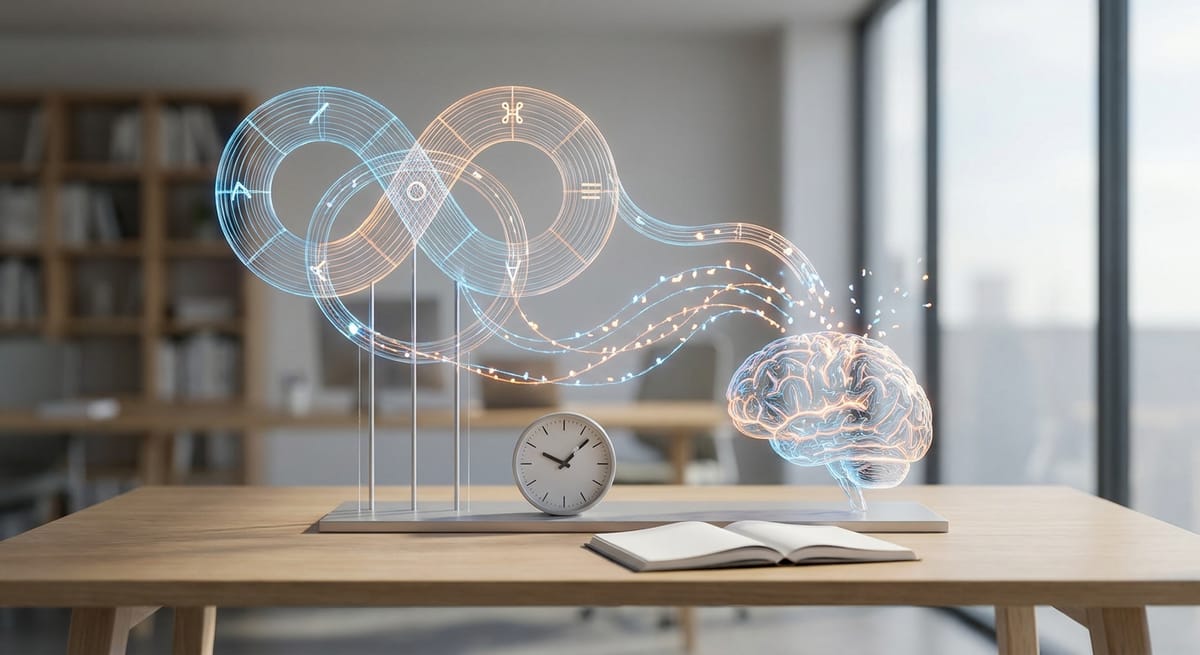 Uncompleted tasks run like open apps in your mind — silently draining your focus and energy all day.
What’s actually happening in your brain when you delay
Procrastination is essentially a tug-of-war between two key players in your brain — and understanding who wins, and why, is everything.
- The amygdala (the emotional centre): Your ancient, survival-driven threat detector. When you look at a daunting task, it doesn’t see “an Excel spreadsheet.” It sees a threat to your ego, your self-esteem, or your comfort. It demands immediate relief — right now, not later.
- The prefrontal cortex (executive control): The rational, evolved part of your brain that plans for the future, weighs consequences, and knows that doing your taxes today prevents a headache next month.
When you procrastinate, the threat response wins. The amygdala’s alarm drowns out executive control, effectively screaming: “That task makes us feel anxious and stupid — let’s watch cat videos and feel safe instead!” That picture is a simplification — no single brain region acts alone — but the pattern is well established. Researchers Fuschia Sirois and Timothy Pychyl, who pioneered the emotion regulation account of procrastination, call it short-term mood repair: giving in to feel good now, helped along by present bias, our tendency to value the immediate over the future. It kept our ancestors alive on the savannah. It does not, however, help you file your tax return.
What emotions are we actually avoiding?
The emotions beneath procrastination are usually one of four: fear of failure, perfectionism, boredom, or confusion. Each makes a task feel emotionally unsafe, so the brain reaches for relief instead of action — and naming which one is present is the essential first step to regulating it. A task typically triggers one or more of these internal states:
- Fear of failure (or success): “If I don’t try, I can’t fail.” We protect our self-worth by withholding effort entirely.
- Perfectionism: The standards we set are so impossibly high that the sheer weight of trying to meet them causes paralysis before we’ve even started.
- Boredom and frustration: The task lacks meaning or stimulation, and our brain is hunting for a dopamine hit somewhere — anywhere — else.
- Confusion or lack of clarity: When we don’t know what the very next step is, our brain registers the uncertainty as a threat and retreats to safer ground.
Recognising which of these is driving your avoidance in any given moment is half the battle. You can’t regulate an emotion you haven’t named.
The shift: from self-blame to self-compassion
You cannot solve a problem from the same level of consciousness that created it. Trying to “force” yourself to work through sheer discipline is like driving with the handbrake on — you might move, but you’ll burn out the engine.
The most effective tool for shifting your emotional state is, counterintuitively, simple: self-compassion. A Carleton University study by Michael Wohl, Timothy Pychyl, and Shannon Bennett found that students who forgave themselves for procrastinating before a first exam procrastinated significantly less before the next one. Dr Fuschia Sirois’s research points the same way: chronic procrastinators tend to be markedly lower in self-compassion, and shame keeps the cycle turning. Why? Because self-forgiveness reduces the emotional load of guilt and shame, freeing up the prefrontal cortex to do its job without being hijacked by a defensive amygdala.
This isn’t soft thinking — it’s a neurological mechanism. Less shame means less threat activation, which means more rational capacity to actually get the thing done.
How do I stop procrastinating? 4 science-backed strategies
You stop procrastinating by addressing the emotional root, not the time-management symptoms. That means naming the feeling you are avoiding, shrinking the task until starting feels safe, and building cues that don’t rely on motivation. Here are four practical shifts that work with your brain’s wiring, not against it.
1. Practise affect labelling (name the feeling)
Before you open another browser tab, pause. Close your eyes and ask: “What emotion am I trying to avoid right now?” Is it anxiety about not being good enough? Boredom? Confusion? Simply naming the emotion — “I’m feeling anxious about starting this presentation” — dampens the amygdala’s alarm system and brings the rational prefrontal cortex back online. This technique, known as affect labelling, was demonstrated in UCLA neuroimaging research led by Matthew Lieberman: naming an emotion measurably reduces amygdala activity and engages the prefrontal cortex.
2. Lower the bar to the floor (the two-minute rule)
When a task feels monumental, the emotional resistance is high. Shrink the task until the friction disappears:
- Don’t write the whole report — just write one terrible sentence.
- Don’t do the whole workout — just put on your running shoes.
- Don’t plan the full project — just open the document.
Once you start, the momentum shift is almost instant. The hardest part of any task is nearly always the emotional transition of beginning, not the task itself.
3. Make your future self feel real
Neuroimaging research by psychologist Hal Hershfield shows that when many of us think about our future self — even just next week — the brain’s activity pattern looks closer to the one for a stranger than the one for ourselves. It’s why we gladly dump our work onto “Monday Me” without guilt. To counter this, visualise specifically how relieved “Friday Afternoon You” will feel if you finish this task today. Send a mental thank-you note to “Yesterday You” when you actually do get something done ahead of time. It sounds a bit daft, but the future-self research backs it up: the more real that person feels, the better your choices on their behalf.
4. Create an ignition ritual
Separate the decision to work from the act of working. When you rely on feeling motivated to start, you’re at the mercy of your emotional state. Instead, build a physical anchor that signals to your brain it’s safe to transition into focus:
- Clear your desk of everything unrelated to the task.
- Put on a specific playlist or noise-cancelling headphones.
- Set a timer for 15 minutes — not the whole project, just 15 minutes.
The ritual does the emotional heavy lifting. You don’t have to feel ready; the ritual tells your nervous system that ready is the default state right now.
 A simple ignition ritual — clear desk, headphones on, timer set — removes the need to “feel motivated” before starting.
Key takeaways
- Procrastination is emotion regulation gone wrong, not a character flaw — your brain is trying to escape discomfort, not be difficult.
- Your brain’s threat response routinely overrides executive control, and short-term mood repair wins over long-term goals until you intervene deliberately.
- The Zeigarnik Effect means unfinished tasks drain your mental energy even when you’re “doing nothing” — completing them is as much about reclaiming focus as it is about productivity.
- Self-compassion is a neurological tool: forgiving yourself for past procrastination reduces shame, frees up executive function, and makes the next task easier to start.
- Practical fixes — affect labelling, the two-minute rule, future-self visualisation, and ignition rituals — work precisely because they target the emotional root, not just the schedule.
- The hardest part of any task is almost always the emotional transition of starting, not the work itself.
Frequently asked questions
Why do I procrastinate even on things I actually want to do?
Because procrastination isn’t about the task — it’s about the emotions the task triggers. Even a project you’re excited about can activate fear of failure, perfectionism, or the paralysis of not knowing where to start. Your brain’s threat response doesn’t distinguish between “tasks you want to do” and “tasks you don’t”. If a task carries any threat to your ego or comfort, it will push for relief regardless of your enthusiasm for the end result.
Is procrastination linked to ADHD or anxiety?
Yes — both are strongly associated with procrastination, though through different mechanisms. ADHD affects executive function and dopamine regulation, making task initiation genuinely harder neurologically. Anxiety heightens the amygdala’s threat response, making avoidance feel more urgent. If procrastination is significantly impairing your daily life, it’s worth speaking to a qualified professional rather than treating it purely as a self-development challenge.
Does the two-minute rule actually work, or is it just productivity fluff?
It works — but not because of magic. It works because the barrier to starting is almost entirely emotional, not practical. Committing to just two minutes lowers the emotional stakes enough for the threat response to stand down, allowing your executive control to engage. Once you’re in motion, the Zeigarnik Effect actually works in your favour: your brain wants to complete what it has started, so momentum builds naturally.
What’s the difference between productive procrastination and being genuinely busy?
The tell is the question: “Am I doing this to move my life forward, or to avoid feeling something uncomfortable?” Genuine busyness means tackling priorities in order of importance. Productive procrastination means choosing lower-stakes tasks because they feel safer — even when you know the big task is sitting there waiting. The activity looks identical from the outside; the emotional driver underneath is completely different.
How long does it take to change a procrastination habit?
There’s no universal timeline — it depends on how ingrained the emotional patterns are and how consistently you practise the interventions. Research on habit formation suggests new behavioural patterns stabilise somewhere between 18 and 254 days, with a median of 66 days according to Lally et al. (2010). The key is consistency with the emotional regulation tools — not white-knuckling your way through willpower.
If this resonated, the next step is understanding the deeper mindset patterns that keep emotional avoidance locked in place. Explore the Quantum Self Development mindset resources for frameworks that get beneath the surface and create lasting change — because real transformation is always about mechanism, never magic.