Does Habit Tracking Work? What the Psychology Actually Says
Four weeks from now there are two versions of you. One of them thinks they've been meditating most mornings. The other one knows — because there's a grid on the fridge with seventeen ticks and eleven blank squares, and no story can argue with a blank square.
TL;DR
- Does habit tracking work? Yes — because it makes an invisible behaviour visible, and what gets measured gets managed.
- The active ingredient isn’t the tick box; it’s self-monitoring, cue reinforcement, and the small dopamine hit of a completed streak.
- Tracking backfires when the streak becomes the goal — so track to notice, not to punish, and forgive the missed day.
What’s in this guide
- Does habit tracking actually work?
- The mechanism: why writing it down changes behaviour
- What does the research say about habit tracking?
- When does habit tracking backfire?
- How do you track habits so it actually sticks?
- Habit tracking methods compared
- Key takeaways
- Frequently asked questions
Four weeks from now there are two versions of you. One of them thinks they’ve been meditating most mornings. The other one knows — because there’s a grid on the fridge with seventeen ticks and eleven blank squares, and no story can argue with a blank square.
So, does habit tracking work? The short answer is yes, but not for the reason most people assume. It isn’t the app, the bullet journal, or the satisfying little checkmark that changes you. It’s what tracking forces your brain to do that everyday intention never does — pay honest attention.
There’s nothing mystical in that. Tracking works because of what it does to attention and feedback — and once you can see those moving parts, the humble tick box turns from productivity theatre into a genuine lever on behaviour.
 The visible chain of ticks is the point — it turns a fuzzy intention into hard evidence.
Does habit tracking actually work?
Yes — habit tracking works when it functions as self-monitoring, the deliberate act of recording your own behaviour so it becomes visible to you. The recording is the intervention, not the record.
Here’s the everyday version of a well-studied clinical idea. In behaviour therapy, self-monitoring is a core technique: patients log their eating, their moods, their smoking — and the logging alone often shifts the behaviour before any other treatment begins. Psychologists call this reactivity: the act of measuring a behaviour changes it.
Your brain runs on prediction and feedback. Left untracked, most habits live in a fog of vague self-belief — “I read quite a lot,” “I hardly ever skip the gym.” Tracking replaces the fog with data. And data is uncomfortable in exactly the way growth requires.
The mechanism: why writing it down changes behaviour
Habit tracking works through three overlapping mechanisms: it makes behaviour visible, it turns an abstract intention into a concrete cue, and it delivers a small reward that reinforces the loop.
Let’s take them one at a time, because this is where the tick box earns its keep.
1. Visibility beats memory
Your memory is a storyteller, not a ledger. It edits, flatters, and forgives. A tracker is a ledger. When you can see six days on and one day off, self-deception has nowhere to hide. This is the same principle behind food diaries and expense logs — the measurement itself creates accountability.
2. The tracker becomes the cue
Every habit runs on a loop: cue, routine, reward. A tracker you see each morning becomes a reliable cue — a visual prompt that fires the routine. This dovetails neatly with habit stacking, where you anchor a new behaviour to an existing one. The tracker is simply another anchor point in your environment.
3. The completed square is a micro-reward
Marking a habit complete produces a small, satisfying hit of reward — a flicker of dopamine tied to progress. As the journalist Charles Duhigg explains in The Power of Habit, it’s the reward that cements a loop. James Clear makes a related point in Atomic Habits: “Habit tracking is powerful because it leverages multiple Laws of Behavior Change. It simultaneously makes a behavior obvious, attractive, and satisfying.” That’s Clear’s phrasing, not mine — and it captures the mechanism precisely.
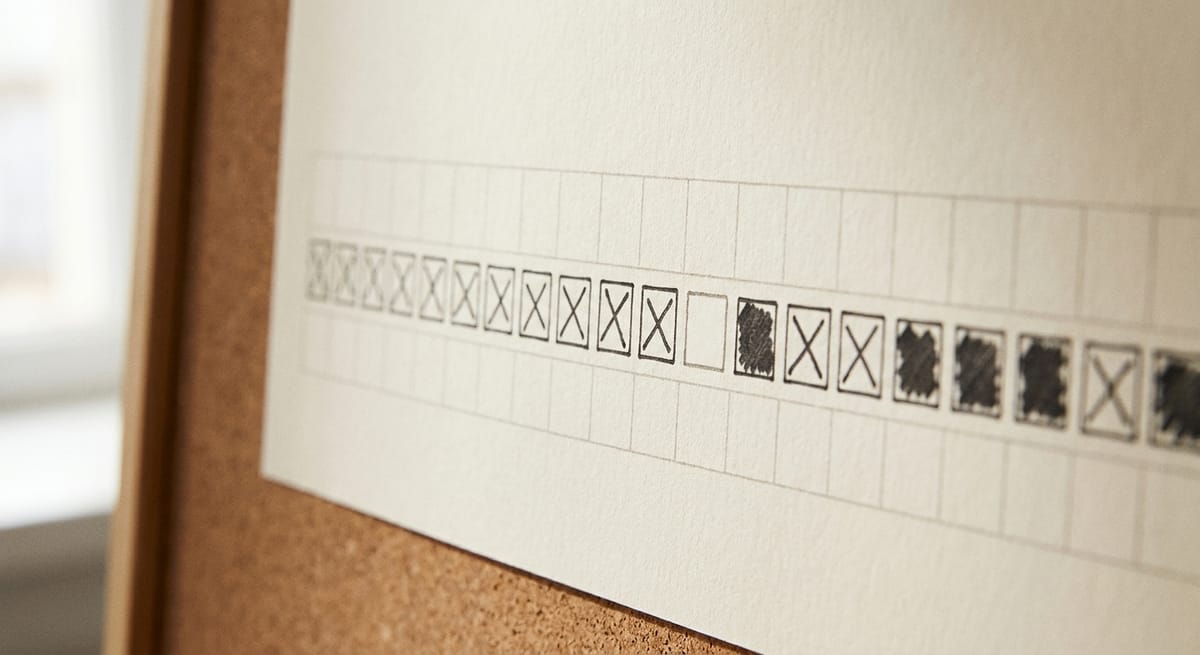 The mechanism in one image: visible progress, a clear cue, and the satisfaction of not breaking the chain.
What does the research say about habit tracking?
The evidence is genuinely encouraging, though I want to be honest about its edges. Self-monitoring is one of the most reliably effective behaviour-change techniques we have.
A large systematic review of self-monitoring in physical activity and diet, published in Health Psychology (Michie et al., 2009), found that interventions including self-monitoring were significantly more effective than those without it. Self-monitoring is also a foundational technique catalogued in the Behaviour Change Technique Taxonomy, the standard reference researchers use to describe what actually works.
The famous “66 days” figure — the average time for a behaviour to become automatic — comes from Phillippa Lally’s 2010 study in the European Journal of Social Psychology. What often gets lost is the range: automaticity took anywhere from 18 to 254 days depending on the person and the habit. Tracking matters most during that long, unglamorous formation window, when the behaviour hasn’t yet gone automatic and your memory can’t be trusted to report on it.
The caveat: much of this research measures self-monitoring as part of broader programmes. Tracking rarely works in isolation. It’s a lever, not an engine — which is exactly why the next section matters.
When does habit tracking backfire?
Habit tracking backfires when the streak becomes the goal instead of the behaviour — when a broken chain triggers shame, and shame triggers avoidance.
You’ve felt this if you’ve ever kept a perfect run of workouts, missed a day, and then quietly abandoned the whole thing. That’s not weakness. It’s a well-documented pattern that behavioural psychologists call the what-the-hell effect: once a self-imposed rule is broken, we treat the lapse as total failure and give ourselves permission to collapse entirely.
It’s perfectionism wearing a lab coat — all-or-nothing thinking, one of the classic cognitive distortions. The reframe that dissolves the self-blame is simple: missing once is an accident; missing twice is the start of a new habit. That’s Clear’s rule: never miss twice.
Tracking also fails when:
- You track too much. Fifteen habits on day one is a recipe for overwhelm. Track one or two keystone behaviours and let them pull others along.
- The metric is vague. “Be healthier” can’t be ticked. “Walk 20 minutes” can.
- You confuse the tick with the outcome. A tracker measures effort, not results. Gaming your own grid helps no one.
If your tracking is fuelled by self-criticism rather than curiosity, the problem may run deeper than the habit. That’s where work on limiting beliefs does more good than any grid.
How do you track habits so it actually sticks?
Track for feedback, not for a flawless streak. The goal is honest visibility with the lowest possible friction, so the recording never becomes another chore to resent.
Here’s a practical sequence I’d recommend to anyone starting out:
- Pick one or two habits, not ten. Choose keystone habits — the ones that make other good behaviours easier.
- Make the metric binary. Did you do it, yes or no? Binary is honest and fast.
- Put the tracker where you’ll see it. Fridge, bedside, phone home screen. An unseen tracker is a dead tracker.
- Track immediately after the behaviour. Delay lets memory distort the record.
- Apply the two-day rule. Never miss twice. Protect the chain, not the perfection.
- Review weekly, not obsessively. Look for patterns — which days fail, which contexts help — and adjust your environment, not your willpower.
If willpower is where you keep coming unstuck, read up on why willpower fails — because the answer is almost always to change the environment, not to try harder. Reducing friction and stacking cues will outperform grit every time.
Habit tracking methods compared
There’s no single best tool — only the one you’ll actually use. Here’s how the common methods stack up on the factors that decide whether tracking sticks.
| Method | Friction | Visibility | Best for | Watch out for |
|---|---|---|---|---|
| Paper wall calendar | Very low | High (always in view) | 1–3 simple daily habits | Not portable; easy to forget when away |
| Bullet journal / notebook | Medium | Medium | People who enjoy the ritual of writing | Can become over-designed and abandoned |
| Habit-tracking app | Low | Low unless notifications on | Multiple habits, reminders, data trends | Notification fatigue; opening the app becomes a distraction |
| Spreadsheet | Medium-high | Low | Data-minded people who review weekly | Rarely seen day to day; easy to skip |
A South African reader on a budget needn’t spend a cent: a printed grid on the fridge outperforms a R150-per-month premium app if the app lives buried on a fourth home screen. The best tracker is the one your eyes land on before your excuses do.
One warning worth its own line: if your tracker lives on your phone, it competes with everything else on that phone. If you find yourself opening the app and losing twenty minutes, tackle phone distraction first — otherwise the tool designed to build focus quietly erodes it.
Key takeaways
- Habit tracking works chiefly through self-monitoring — the act of recording changes the behaviour before anything else does.
- The mechanism has three parts: visibility beats memory, the tracker becomes a cue, and the completed mark is a micro-reward.
- The research (Michie, Lally and the Behaviour Change Technique Taxonomy) supports self-monitoring, but usually as part of a broader system, not a standalone fix.
- Tracking backfires when the streak becomes the goal; the what-the-hell effect turns one lapse into total collapse.
- Track for feedback, keep it binary, keep it visible, and never miss twice.
- The best method is the one with the lowest friction and the highest visibility for you — not the most impressive app.
Frequently asked questions
Does habit tracking work for everyone?
Does habit tracking work universally? No — it works best for people who track with curiosity rather than self-punishment. If a missed day sends you into shame and avoidance, tracking can backfire. For most people, though, the self-monitoring effect is reliable: making a behaviour visible reduces self-deception and gently nudges the behaviour toward your stated goal.
How long should I track a new habit?
Track until the behaviour feels automatic — which Phillippa Lally’s 2010 research found ranged from 18 to 254 days, averaging around 66. Practically, keep tracking through the formation window when your memory can’t be trusted to report accurately. Once the habit runs on autopilot and skipping feels strange, you can retire the tracker without losing the behaviour.
Is a habit-tracking app better than paper?
Neither is inherently better; the right choice is whichever you’ll actually see and use. Apps offer reminders and trend data but risk notification fatigue and phone distraction. Paper is frictionless and always visible but not portable. Match the tool to your context — and if your phone is a distraction trap, choose paper.
What is the two-day rule in habit tracking?
The two-day rule states: never miss twice. Missing once is an accident and won’t derail you; missing twice begins a new pattern of not doing the habit. This single rule neutralises the what-the-hell effect, where one broken streak triggers total collapse. It keeps you focused on consistency over time rather than an unbroken, fragile chain.
Why does tracking a habit make me more likely to do it?
Because of reactivity — the well-documented finding that measuring a behaviour changes it. Recording forces honest attention, replaces vague self-belief with data, and provides a small reward each time you complete the entry. Together these make the behaviour more obvious, more accountable, and more satisfying, which strengthens the underlying habit loop.
Ready to turn one tracked habit into lasting change? Explore our full library of mechanism-first guides in the Habits section, or start with the fundamentals over at Start Here — the grid on your fridge is only the first lever.