Why Multitasking Doesn't Work: The Proven Brain Science
It's 3:14 in the afternoon. You've got fourteen browser tabs, a half-written email, a message notification pulsing in the corner, and a nagging sense that you're being productive. Here's the uncomfortable truth about why multitasking doesn't work: you aren't doing four things at once. You're…
TL;DR
- Your brain doesn’t multitask — it rapidly switches, and each switch bleeds time, accuracy and mental energy.
- Studies suggest heavy media multitaskers perform worse at filtering distraction, not better.
- The fix isn’t more discipline — it’s single-tasking by design: batching, friction, and one open loop at a time.
What’s in this guide
- Why multitasking doesn’t work: the myth exposed
- What actually happens in your brain
- Is anyone genuinely good at multitasking?
- The hidden costs you don’t notice
- How do you stop multitasking?
- Key takeaways
- Frequently asked questions
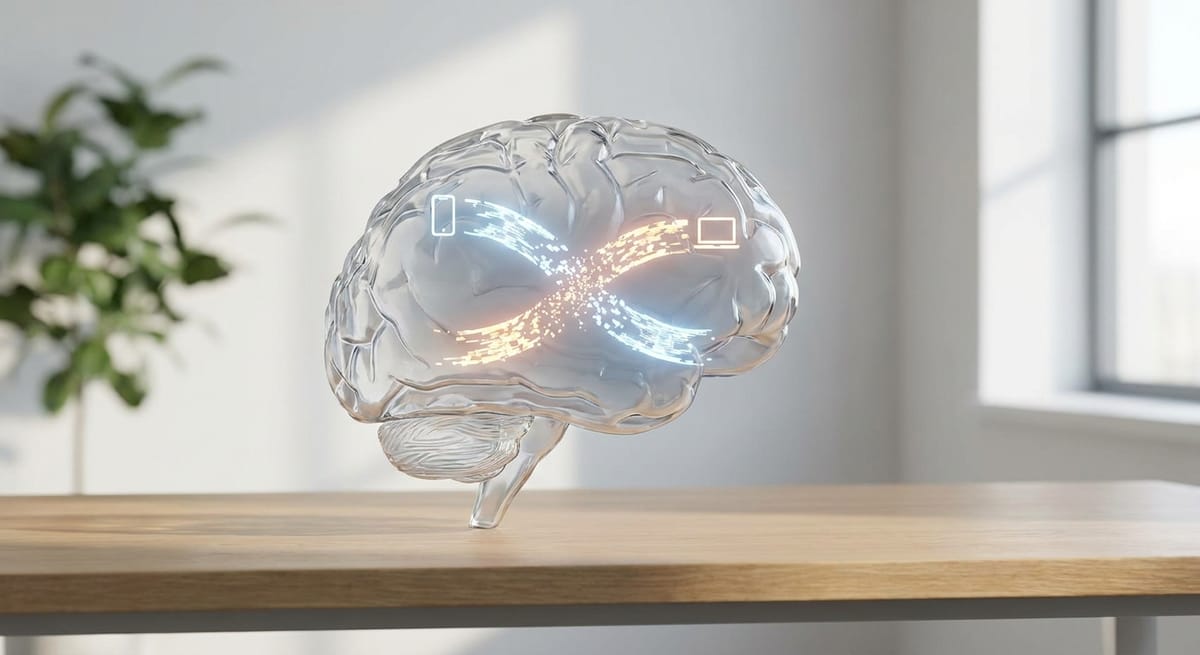 Your attention is a spotlight, not a floodlight — it points at one thing at a time.
It’s 3:14 in the afternoon. You’ve got fourteen browser tabs, a half-written email, a message notification pulsing in the corner, and a nagging sense that you’re being productive. Here’s the uncomfortable truth about why multitasking doesn’t work: you aren’t doing four things at once. You’re doing one thing badly, then another thing badly, and paying a toll every time you cross over.
We tell ourselves multitasking is a skill — a sign of a fast, capable mind. The neuroscience says something less flattering. The brain has a narrow attentional bottleneck, and when you force two demanding tasks through it, they queue.
Real change isn’t magic, it’s mechanism. So let’s look at the mechanism — because once you understand what’s actually happening under the bonnet, the tactics stop sounding like productivity platitudes.
Why multitasking doesn’t work: the myth exposed
Multitasking, as most people mean it, is a myth — what you’re really doing is task-switching: shifting attention back and forth so quickly it feels simultaneous. It isn’t.
Think of your conscious attention as a spotlight, not a floodlight. It illuminates one region of your mental workspace at a time. When you “multitask” between two goal-directed activities — writing and listening, driving and texting — you’re swinging that spotlight side to side, and everything in the dark between swings goes unprocessed.
Your brain can run parallel processes, but only when one is automatic. You can walk and talk because walking is handled below conscious awareness. The moment both tasks demand executive attention — planning, language, decision-making — they compete for the same prefrontal real estate, and cooperation ends.
The clinical cousin of “I’m great at multitasking” is a comforting self-story that quietly costs you. Naming it as task-switching is the first reframe: you’re not a super-processor, you’re a spotlight operator working overtime.
What actually happens in your brain
Every time you switch tasks, your brain pays a switch cost — a measurable lag while it reloads the rules, goals and context of the new task. Small on its own; ruinous in aggregate.
The classic work here comes from Robert Rogers and Stephen Monsell, and later Joshua Rubinstein, Jeffrey Evans and David Meyer, whose 2001 studies in the Journal of Experimental Psychology showed that shifting between tasks introduced significant time costs — and those costs grew with the complexity and unfamiliarity of the tasks. The American Psychological Association summarised the finding bluntly: even brief mental blocks from switching can cost up to 40% of someone’s productive time.
Two things happen at each switch:
- Goal shifting — deciding to do task B instead of task A.
- Rule activation — turning off the rules for A and loading the rules for B.
That rule activation is the sticky part. The mental “residue” of task A lingers, a phenomenon researcher Sophie Leroy named attention residue in 2009 — part of your mind is still chewing on the last thing while you try to start the next. You feel it as that foggy half-second where you stare at the new document, momentarily unsure what you were about to do.
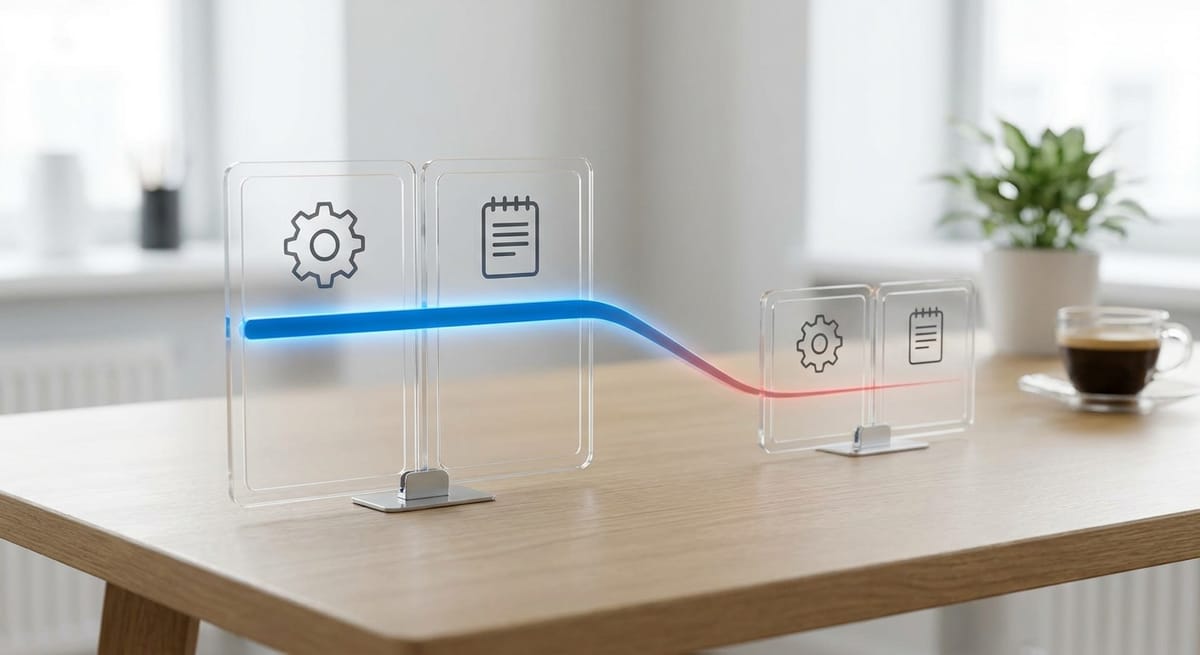 Attention residue: part of your mind lingers on the previous task after you switch.
Is anyone genuinely good at multitasking?
Almost no one — and the people most confident they can multitask tend to be the worst at it. That’s not a jab; it’s a repeated research finding.
A small fraction of people, sometimes called “supertaskers,” show minimal switch costs in lab studies by David Strayer and Jason Watson at the University of Utah. But they’re an outlier — estimated at roughly 2% of the population. Statistically, you are almost certainly not one, and the belief that you are is itself a risk factor.
Stanford’s Clifford Nass, Eyal Ophir and Anthony Wagner ran a now-famous 2009 study on heavy media multitaskers. The prediction was that constant multitaskers would have some hidden edge. They didn’t. Heavy multitaskers were worse at ignoring irrelevant information, worse at organising memory, and slower to switch tasks. The very habit meant to build the skill was eroding it.
| Belief | What research suggests |
|---|---|
| “I multitask efficiently.” | Self-rated multitaskers often perform worst on attention tests. |
| “Multitasking saves time.” | Switch costs can consume up to 40% of productive time (APA). |
| “Practice makes me better at it.” | Heavy media multitaskers show weaker distraction filtering (Stanford, 2009). |
| “Some people are natural multitaskers.” | True “supertaskers” are roughly 2% of people (Utah). |
The hidden costs you don’t notice
The real damage of multitasking isn’t just slower work — it’s degraded thinking, shallower memory, and a nervous system stuck in low-grade alert. You rarely feel these costs directly, which is exactly why they persist.
Memory that doesn’t stick
Encoding a memory needs attention. When you split your focus, information gets processed by shallower systems, so it’s harder to recall later. You read the page and remember nothing — not because you’re forgetful, but because you were never fully there.
Errors that compound
Switch costs don’t just slow you — they raise error rates. On complex tasks, the reloading of rules is imperfect, and mistakes slip through in the residue. In safety-critical settings, that’s the difference between an inbox typo and a swerve.
A quietly frazzled nervous system
Constant switching keeps you in a mild state of arousal — that pinging, twitchy urgency. There’s a sweet spot for performance described by the Yerkes-Dodson law: too little arousal and you’re flat, too much and performance collapses. Chronic multitasking often pushes you past the peak into scattered overwhelm, the same territory that overlaps with anxiety. If that sounds familiar, our guide on how to calm anxiety shares the same underlying mechanism.
The dopamine loop
Every notification you answer delivers a tiny hit of novelty. Over time, switching becomes its own reward — you start seeking it. This is why single-tasking can feel almost uncomfortable at first: you’ve trained your brain to expect the next ping.
How do you stop multitasking?
You stop multitasking by removing the option to switch, not by trying harder to resist it. Willpower is the wrong tool for a design problem — as we explore in why willpower fails, environment beats intention almost every time.
Here’s the mechanism-first approach. Reduce the number of open loops competing for your spotlight, and add friction to the switches you can’t fully close.
- Batch by type. Group similar tasks — all emails, all calls — so you reload one set of rules and stay in it. Fewer context reloads, less residue.
- Single-task in blocks. Work one task for a defined stretch (25–50 minutes) with everything else closed. One spotlight, one target.
- Kill the notifications. Silence, don’t just ignore. Every visible alert is a switch invitation, and resisting it still costs attention.
- Close the loop before you move. Leroy’s research suggests setting a clear stopping point — a quick note on where you’re up to — reduces attention residue when you return.
- Add friction to distractions. Put the phone in another room. This is the same principle behind reducing friction in habits — make the wrong move slightly harder and it stops happening on autopilot.
Notice the pattern: none of this asks you to be more disciplined in the moment. It changes the environment so the disciplined choice is the default one. That’s the reframe that dissolves the self-blame — you were never weak-willed, you were fighting your own design.
Key takeaways
- Multitasking is really task-switching, and each switch charges a cognitive toll in time and accuracy.
- Switch costs can consume up to 40% of productive time, per APA-cited research.
- Heavy multitaskers tend to filter distraction worse — the habit erodes the very skill it promises.
- The costs are largely invisible: weaker memory, more errors, a frazzled nervous system.
- The fix is design, not willpower — batch tasks, block time, and add friction to switching.
Frequently asked questions
Why doesn’t multitasking work in the brain?
Multitasking doesn’t work because the brain has a single attentional bottleneck for demanding tasks — it can’t run two executive processes in parallel. Instead it rapidly switches, and each switch requires reloading the goals and rules of the new task. That reloading costs time, leaves “attention residue” from the previous task, and increases errors, so overall you’re slower and less accurate.
Can some people actually multitask well?
Very few. Research at the University of Utah identified so-called “supertaskers” with minimal switch costs, but they’re estimated at roughly 2% of people. For everyone else, confidence in one’s multitasking ability is a poor predictor of actual performance — self-rated multitaskers often score worst on attention tests. Statistically, assume you are not the exception.
How much time does multitasking actually cost?
The American Psychological Association, citing switch-cost research by Meyer and colleagues, notes that even brief mental blocks caused by shifting between tasks can cost up to 40% of someone’s productive time. The exact figure varies with task complexity, but the direction is consistent — switching is expensive, and it adds up sharply across a busy day.
Is listening to music while working multitasking?
It depends on the demand. Familiar, lyric-free music is largely automatic and rarely competes for executive attention, so it can coexist with focused work. Lyrics engage your language systems — the same ones you need for reading or writing — so they do compete. The rule of thumb: if the second activity needs language or decision-making, it’s genuine multitasking, and it costs you.
How do I train myself to single-task?
Start with design, not discipline. Close every competing loop, silence notifications, and work one task in a defined block. Before switching, jot a note on where you paused to reduce attention residue. Adding friction to distractions — phone in another room — does more than willpower. Over a week or two, single-tasking stops feeling uncomfortable and starts feeling like clarity.
Want to go deeper into how attention, focus and habit actually operate? Explore our Habits library, or start with how to stop overthinking to quiet the mental noise that makes single-tasking feel so hard.